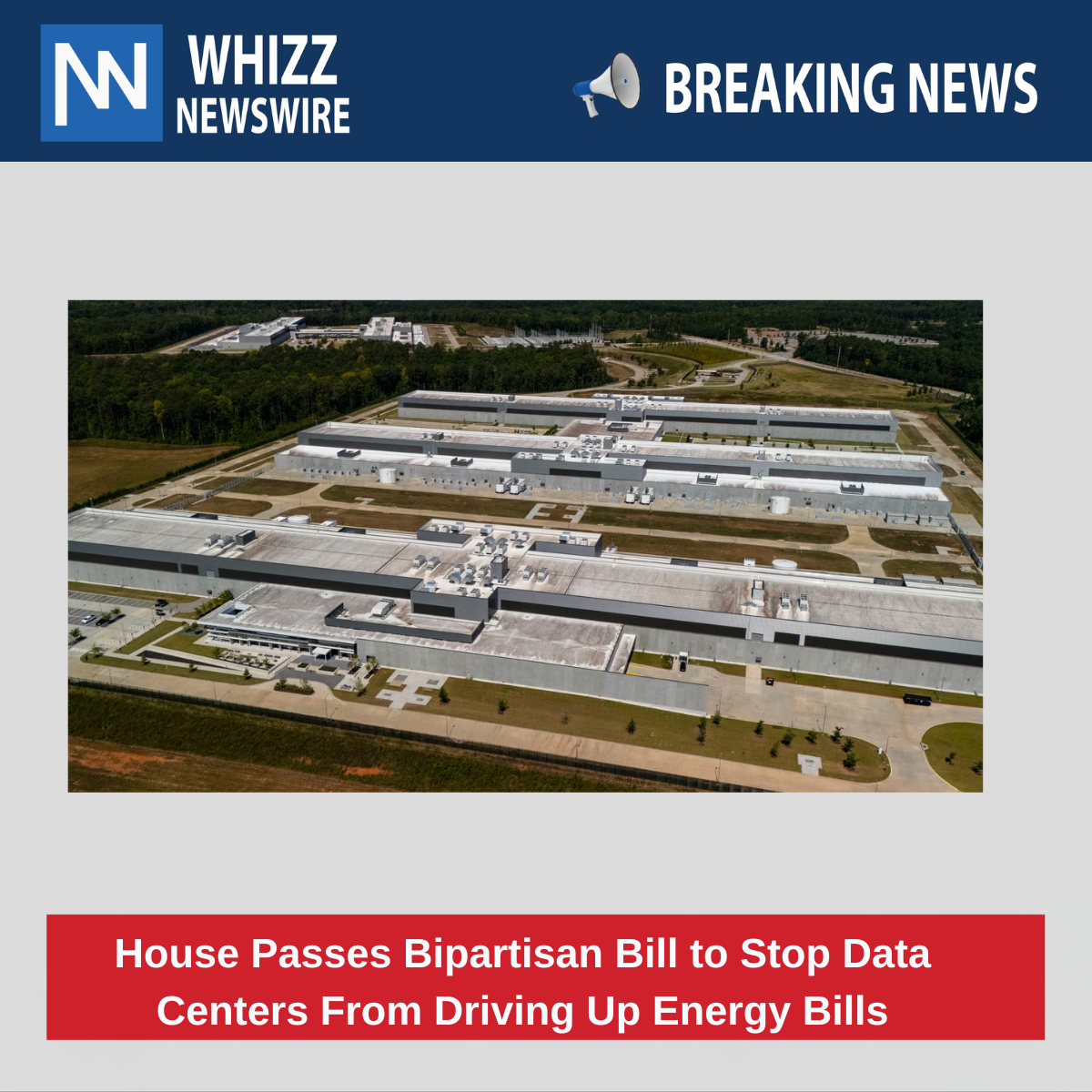
Showing a rare example of unity before the election, the U.S. House gave its strong support to legislation aimed at protecting households and small businesses from having to pay higher electricity bills resulting from the creation of new AI data centres. The Ratepayer Protection Act was passed by a vote of 417 to 3, ordering state utility regulators to take into account a federal standard under which large, power-guzzling data centres would have to pay for all of the cost of grid upgrades necessary to serve them, rather than sharing those costs among all ratepayers.
What the Bill Does and Who It Targets
The bill is being backed by Representatives Gabe Evans (R-Colo.) and Kathy Castor (D-Fla.), both of whom serve on the House Energy and Commerce Committee; it deals with “large-load customers,” meaning data centers that have a peak demand of 100 megawatts or more a level equivalent to that which can power tens of thousands of houses.
According to the proposed standard, these facilities would be responsible for paying for any new generation, transmission lines and distribution upgrades needed to support their operations, as well as giving financial guarantees so that other customers are not left to pick up the bill if the data center later reduces its operations or withdraws altogether.
Maintaining Local Control Over Utility Regulation
The bill does not establish national electricity rates nor does it compel the states to adopt the standard; instead it asks that the state public utility commissions take the framework into account as they draw up their rules, thus maintaining local control over the regulation of utilities while at the same time setting a clear federal benchmark.
Those in support of it refer to it as a “modest first step” in order to prevent the rapid growth of AI from being funded by ordinary families, farmers and small businesses.
Why It Passed So Easily: Data Centers Are a Midterm Flashpoint
The fact that there was such a close consensus shows just how politically sensitive the issue of data centres has become in the run-up to the November midterms.
Although President Donald Trump has promoted these new facilities as essential for the United States to remain competitive with China in the field of artificial intelligence, growing local opposition has emerged as more and more projects are being established in swing states and districts.
Growing Public Concern Over AI Data Centers
A recent poll by the NBC News Decision Desk revealed that almost 70% of the people interviewed were against having AI data centres built in their neighbourhoods, 45% of them being strongly against it.
Other surveys also indicate similar levels of concern regarding the effects on electricity prices, power reliability and water supplies.
How the Issue Is Affecting Lawmakers
For lawmakers who are vulnerable such as Evans, since his race in Colorado is considered a toss-up the vote provided a clear opportunity to demonstrate responsiveness to those concerned about increasing energy costs.
“Hardworking families should not be forced to pay for the energy needs of data centres,” Evans stated following the vote.
“It is true that America needs the infrastructure to take the lead in AI… but we cannot achieve that kind of growth by putting hardworking families, farmers, seniors and small businesses at a disadvantage.”
The Three “No” Votes: “Fails to Meaningfully Protect Our Communities”
Three people voted against the bill: progressive Democrats in the House, Representative Summer Lee from Pennsylvania, Delia Ramirez from Illinois, and Rashida Tlaib from Michigan.
Tlaib stated that the legislation did not go a long way towards protecting our communities and instead advocated for a national moratorium on data centres as well as a ban on the establishment of new ones on federal land.
A number of Senate Democrats have shared this opinion, claiming that the House bill does not go far enough in curbing the shift in utility costs or in dealing with the wider AI risks.
What Happens Next: Senate Uncertainty and Lame-Duck Timing
It is not clear how the bill will proceed in the Senate, since the upper chamber has got its own proposals relating to data centres but has not moved any of them forward.
Since the House is completing its final votes before the midterms and the Senate only plans to be in session for a few more weeks, very little additional AI-related legislation is expected before the subsequent post-election lame-duck session.
As a result, the Ratepayer Protection Act is currently in a state of suspension, even though it is becoming a topic of discussion in closely contested races where opposition to data centres is campaigning to win voters.
The Big Picture: The Growth of AI Compared to Opposition at a Local Level
The vote on the House reflects the growing divide between the nation’s ambitions in the field of AI and the resistance being felt at the local level.
While Washington is focusing on competitiveness and on infrastructure, communities are becoming more concerned about the rapid and large-scale building of data centres and the possibility that their utility bills will have to bear the cost.
The Ratepayer Protection Act is intended to make this boundary clearer by stating that if a hyperscaler requires a new substation or a transmission line in order to operate its AI cluster, then it should be the hyperscaler that pays for it, not the retiree who lives down the road and on a fixed income.
It is up to the Senate, following the election, how it handles the competing priorities to decide whether or not this principle will become law.