
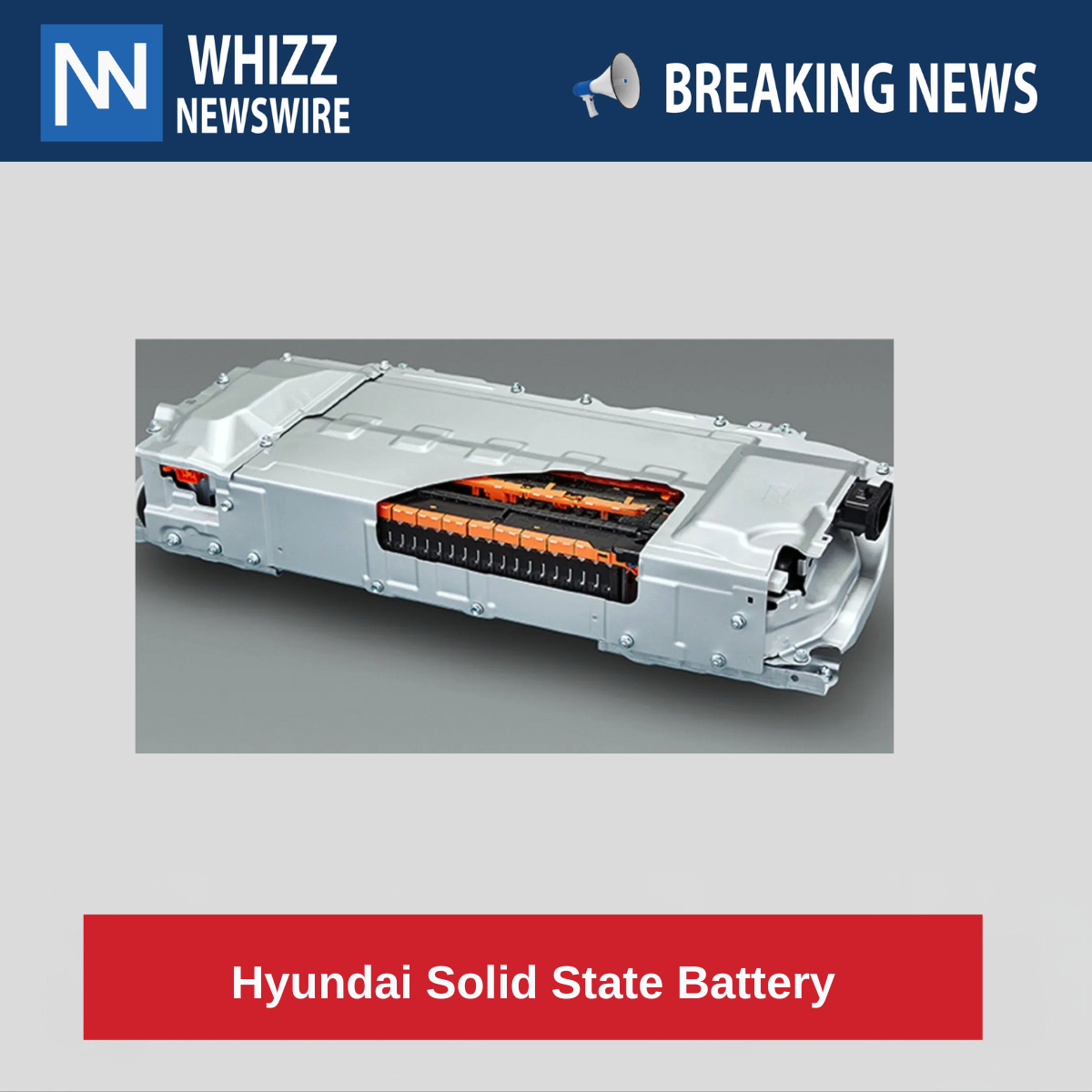
Hyundai’s solid-state battery technology, covering its history, strategy, partnerships, goals, benefits, challenges, and market impact:
What Are Solid-State Batteries?
Before understanding Hyundai’s role, it’s important to grasp what solid-state batteries are:
Traditional lithium-ion batteries use liquid electrolytes to facilitate the movement of lithium ions between the cathode and anode. While effective, these liquid electrolytes pose safety risks, are flammable, and limit the battery’s energy density.
Solid-state batteries, on the other hand, use a solid electrolyte, which can be ceramic, glass, or solid polymer. This change leads to:
- Greater energy density (more range in EVs)
- Faster charging
- Longer lifespan
- Enhanced safety (reduced fire risk)
- Compact design (more efficient use of space)
Hyundai’s Vision and Motivation
Hyundai Motor Group (which includes Hyundai, Kia, and Genesis) has clearly stated its ambition to become a leader in electric mobility. As part of its broader EV roadmap called “Strategy 2025”, Hyundai is:
- Investing tens of billions of dollars into EV development
- Aiming to sell over 3 million EVs annually by 2030
- Building global EV production and battery facilities
- Targeting solid-state batteries to improve EV performance and consumer appeal
Solid-state batteries are central to Hyundai’s strategy because they address consumer concerns around:
- Range anxiety
- Battery degradation
- Long charging times
- EV safety
Hyundai’s Research and Development Efforts
Global R&D Hubs
Hyundai operates advanced R&D facilities in South Korea (Uiwang and Namyang), the U.S. (Hyundai America Technical Center), and Germany. These centers are focusing on next-gen battery chemistry, including:
- Sulfide-based solid electrolytes (high conductivity)
- Oxide-based materials (stability and safety)
- Interface engineering (reducing resistance between electrode and electrolyte)
Solid-State Battery Labs
In partnership with Hyundai Mobis (Hyundai’s parts division), Hyundai has built a pilot line to develop and test prototype solid-state cells. These are being refined for mass production.
Key Partnerships and Investments
Hyundai understands that achieving breakthroughs in solid-state batteries requires collaboration. Major initiatives include:
1. Investment in Solid Power
In 2021, Hyundai invested in Solid Power, a U.S.-based startup also supported by Ford and BMW. Solid Power is developing sulfide-based solid-state cells with high energy densities and safer operation.
- Hyundai is working with Solid Power on prototyping and validation
- Solid Power delivers sample cells for integration and testing in Hyundai’s systems
2. Collaboration with Ionic Materials
Hyundai has also collaborated with Ionic Materials, a Massachusetts company developing polymer-based solid electrolytes that can operate at room temperature and are easier to scale.
- Hyundai provided funding and technical support
- Focused on low-cost solid-state materials with simpler manufacturing processes
3. Academic Collaborations
Hyundai partners with universities and national labs in:
- South Korea
- The United States
- Germany
These include research into lithium metal anodes, interfacial stability, and scaling solid-state cell design for real-world use.
Hyundai’s Roadmap for Solid-State Batteries
Development Phases
| Phase | Timeframe | Focus |
| Phase 1 | 2020–2024 | Basic research, lab prototypes |
| Phase 2 | 2024–2027 | Pilot line, real-world testing |
| Phase 3 | 2028–2030 | Pre-production, limited deployment |
| Phase 4 | 2030+ | Mass production, commercial launch |
First Deployment Likely
Hyundai may first introduce solid-state batteries in premium models like:
- Genesis luxury EVs
- High-performance N-series EVs
- Flagship long-range SUVs
Advantages of Solid-State Batteries for Hyundai EVs
| Feature | Traditional Lithium-Ion | Solid-State |
| Energy Density | ~250 Wh/kg | Up to 500 Wh/kg |
| Range | 300–500 km | Up to 800–1000 km |
| Charge Time | 30–60 mins | <15 mins (expected) |
| Safety | Flammable liquid | Stable solid electrolyte |
| Lifespan | 1000 cycles | >3000 cycles (goal) |
These benefits will make Hyundai’s EVs more competitive and appealing in global markets, especially in Europe and North America.
Challenges Hyundai Must Overcome
- Scalability
- Producing solid-state batteries at scale is difficult due to material handling and manufacturing complexity.
- Hyundai needs to build new factories with custom equipment.
- Producing solid-state batteries at scale is difficult due to material handling and manufacturing complexity.
- Cost
- Solid electrolytes are currently more expensive.
- Hyundai aims to reduce cost per kWh to compete with lithium-ion cells by 2030.
- Solid electrolytes are currently more expensive.
- Durability
- Ensuring batteries maintain capacity over thousands of cycles without forming dendrites (metal filaments that cause short circuits).
- Ensuring batteries maintain capacity over thousands of cycles without forming dendrites (metal filaments that cause short circuits).
- Temperature Performance
- Solid-state batteries need to perform well in extreme cold or heat, especially in key markets like Canada, Norway, or the Middle East.
- Solid-state batteries need to perform well in extreme cold or heat, especially in key markets like Canada, Norway, or the Middle East.
Market Implications and Future Impact
If Hyundai successfully commercializes solid-state batteries, it could:
- Leapfrog competitors in the EV market
- Cut down the EV charging infrastructure pressure
- Boost EV adoption globally, especially in regions with range anxiety
- Reduce dependence on rare earths, as solid-state batteries can use alternative materials
Conclusion
Hyundai is actively investing in the future of solid-state battery technology as part of its broader EV leadership strategy. Through internal R&D and partnerships with innovative startups like Solid Power and Ionic Materials, the company is preparing for pre-commercial testing by 2027 and a mass-market rollout around 2030.
This move aligns with the industry’s shift toward safer, longer-lasting, and more efficient energy storage, positioning Hyundai to be a formidable force in the global electric vehicle landscape.
For similar content visit here