
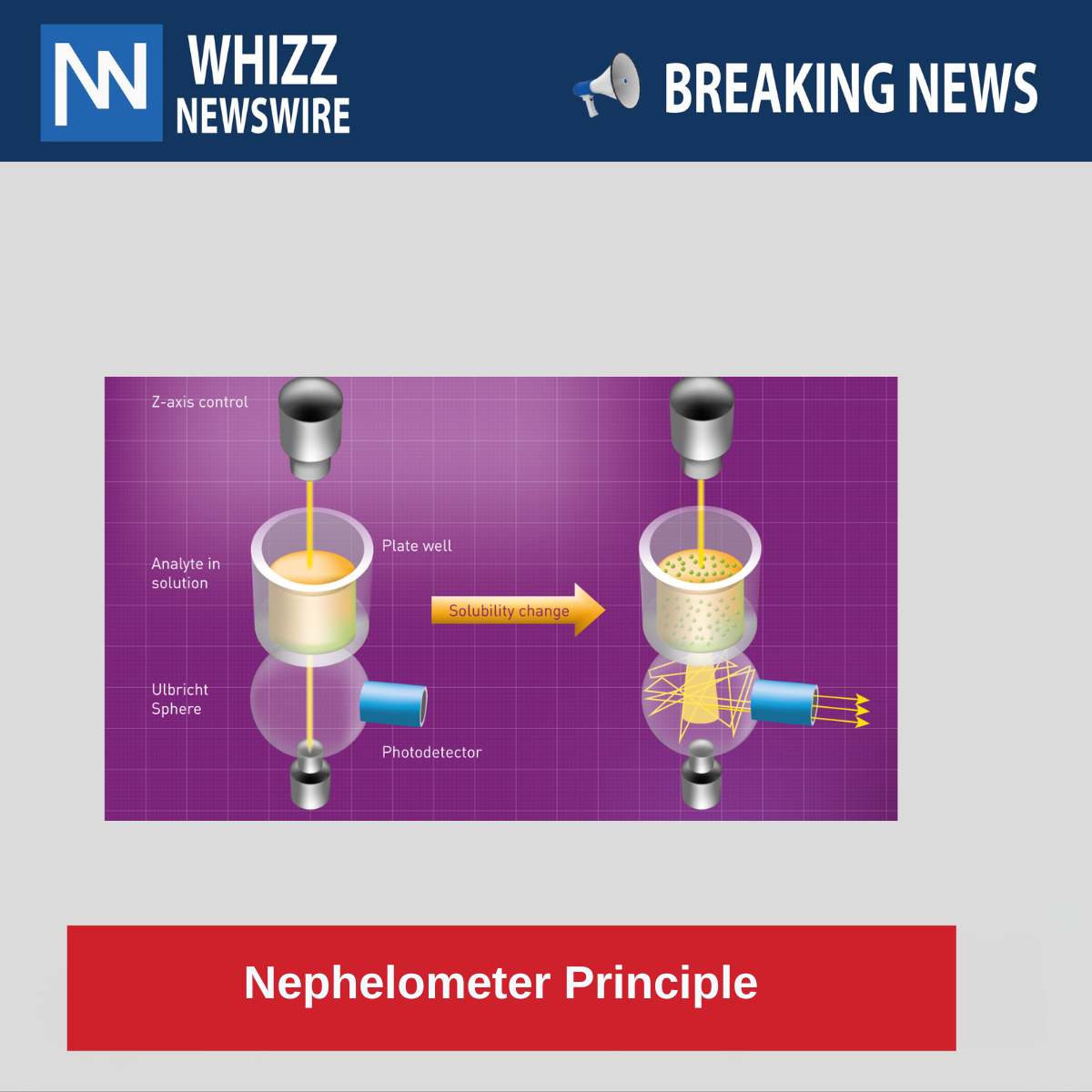
Nephelometer principle, expanded further for deeper understanding:
What is a Nephelometer?
A nephelometer is an optical instrument that measures the scattering of light by suspended particles in a medium usually liquid or gas. It is a widely used tool for measuring turbidity (cloudiness or haziness) in water, and also for monitoring air pollution, clinical diagnostics, and industrial hygiene.
The Core Principle – Light Scattering
The working of a nephelometer is fundamentally based on the Tyndall Effect or Rayleigh and Mie scattering, depending on particle size.
- Tyndall Effect: Visible scattering of light by colloidal particles. It’s seen when particles are large enough to scatter light but not large enough to settle.
- Rayleigh Scattering: Occurs with very small particles (diameter << wavelength of light).
- Mie Scattering: Happens with larger particles (diameter ≈ wavelength of light or greater).
In a nephelometer:
- A light beam (usually from a laser or LED) passes through a sample.
- Particles in the sample scatter the light in various directions.
- A detector is placed at an angle usually 90° from the light source to measure the intensity of the scattered light.
- The more particles (or the higher the turbidity), the more light is scattered and detected.
- The instrument converts the light intensity into a numerical value usually in NTU (Nephelometric Turbidity Units).
Process Flow (Step-by-Step)
- Sample Introduction: A liquid or gas sample containing particles is placed into the instrument’s sample chamber.
- Light Emission: A focused light source (commonly infrared or white light) is directed at the sample.
- Interaction: Particles in the sample scatter the incoming light.
- Detection: A photo-detector or photodiode, usually placed at a 90° angle to the beam, picks up scattered light.
- Signal Conversion: The scattered light is transformed into an electrical signal.
- Data Processing: An internal processor interprets the signal strength and calculates a turbidity or concentration value.
- Display Output: The turbidity (or particle concentration) is shown on a digital screen, often in NTU or mg/m³.
Applications of Nephelometers
| Area | Use |
| Water Treatment | Monitor drinking water turbidity, wastewater contamination |
| Air Quality Monitoring | Measure particulate matter (PM2.5, PM10) in the air |
| Clinical Laboratories | Measure immune complexes, proteins like CRP, IgG, IgA |
| Food & Beverage | Quality control by monitoring haze or cloudiness in liquids |
| Meteorology | Measure atmospheric visibility and haze levels |
| Pharmaceuticals | Control clarity of injectable liquids |
Measurement Units
- NTU (Nephelometric Turbidity Units): Standard unit for turbidity.
- FNU (Formazin Nephelometric Unit): Used in ISO 7027 standard, typically with infrared light.
- mg/m³ or μg/m³: Used for measuring airborne particles.
Types of Nephelometers
1. Turbidity Nephelometers
- Used in water treatment and environmental monitoring.
- Measures light scatter to determine turbidity in liquids.
2. Aerosol Nephelometers
- Used in air pollution studies.
- Detects light scattered by dust, smoke, and airborne particulates.
3. Clinical Nephelometers
- Used in medical diagnostics.
- Measures antigen-antibody reactions and protein concentrations.
Advantages of Nephelometers
- Non-destructive analysis
- Fast and real-time readings
- High sensitivity for low concentrations
- Can be automated and used continuously
- Versatile: suitable for both air and water applications
Limitations
- Interference from colored samples, fluorescent compounds, or air bubbles.
- Requires calibration with standard solutions like Formazin.
- Particle shape and refractive index can affect scattering.
- Not suitable for very high concentrations without dilution.
Scientific Insight: Scattering Angle Importance
- 90° angle: Most nephelometers detect scattered light at a right angle to minimize reflection and interference from the light source.
- Multi-angle nephelometers: Advanced versions use detectors at multiple angles for better accuracy and particle characterization.
Diagram (Conceptual – Not Shown Here)
Imagine a horizontal beam of light passing through a water-filled glass cuvette. Suspended particles in the water scatter the light. A detector placed to the side (90°) of the light path measures how much light hits it. That signal tells the machine how “cloudy” the sample is.
Conclusion
A nephelometer is a powerful instrument that uses scattered light to measure turbidity or particle concentration. Its applications span from ensuring clean drinking water, to diagnosing diseases, to monitoring urban air pollution. By understanding and utilizing the light-scattering principle, nephelometers provide accurate, reliable, and real-time data critical in both industrial and scientific fields.
For similar content visit here