
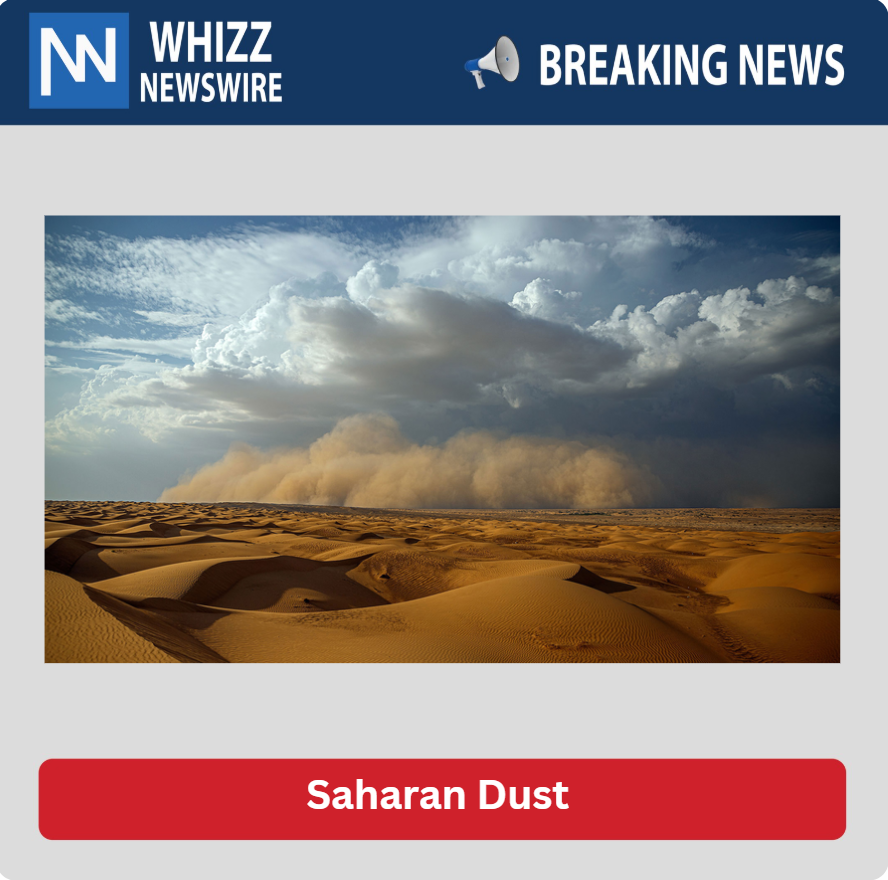
Saharan Dust refers to tiny mineral particles mostly sand, clay, and silt lifted from the Sahara Desert and transported thousands of miles by the wind.
- The Sahara Desert, located in North Africa, is the largest hot desert in the world, stretching over 3.6 million square miles across 11 countries.
- It’s a powerful source of airborne dust each year, it’s estimated that over 100 million metric tons of Saharan dust are blown into the atmosphere.
- This dust is so fine and light that it can stay suspended in the air for days or weeks, traveling thousands of kilometers over oceans and continents.
How Does Saharan Dust Travel So Far?
The long-distance journey of Saharan dust is powered by a weather system known as the Saharan Air Layer (SAL).
Step-by-Step Breakdown:
- Formation of the SAL
- The Saharan Air Layer forms during the summer months when intense heat over the desert creates a mass of hot, dry, and dusty air.
- This layer sits about 1.5 to 6 kilometers above the Earth’s surface and can be as thick as 3 kilometers.
- The Saharan Air Layer forms during the summer months when intense heat over the desert creates a mass of hot, dry, and dusty air.
- Lifting Dust Into the Atmosphere
- Strong surface winds, especially from dust storms or seasonal trade winds, lift loose desert soil into the air.
- This is most common in late spring to early autumn, particularly from May through August.
- Strong surface winds, especially from dust storms or seasonal trade winds, lift loose desert soil into the air.
- Transportation Across the Globe
- The SAL carries this dust westward, riding the trade winds across:
- The Atlantic Ocean
- Into the Caribbean
- Down into South America
- Even reaching the United States, especially Florida and Texas
- The Atlantic Ocean
- The SAL carries this dust westward, riding the trade winds across:
- Eastern Flow (Europe & Middle East)
- Saharan dust also travels east and north into the Mediterranean, Middle East, and Europe, impacting countries like:
- Spain
- Greece
- Italy
- France
- Saudi Arabia
- Spain
- Saharan dust also travels east and north into the Mediterranean, Middle East, and Europe, impacting countries like:
Scale of Movement
To understand how massive this is:
- NASA estimates that 182 million tons of Saharan dust are blown into the atmosphere every year.
- Of this, about 27.7 million tons reach the Amazon Basin, acting as natural fertilizer.
- Plumes of dust can stretch over 5,000 kilometers, forming giant clouds visible from space.
In June 2020, a massive cloud nicknamed the “Godzilla dust plume” traveled from Africa to the Gulf Coast of the U.S., covering skies in a hazy orange-brown color for days.
What Is Saharan Dust Made Of?
This isn’t just “sand.” Saharan dust is a complex cocktail of:
| Component | Description |
| Fine Sand & Clay | Ground-down particles of quartz and silicate from desert rocks |
| Minerals | Rich in iron, phosphorus, and calcium essential nutrients for plants |
| Microorganisms | Bacteria, fungal spores, viruses some survive transoceanic travel |
| Organic Material | Plant matter and sometimes pollutants or pesticides |
Some scientists have even discovered marine bacteria and DNA fragments in Saharan dust samples raising questions about microbial travel and global ecosystems.
Where Does Saharan Dust Land?
Saharan dust settles all around the world, depending on wind direction and weather. Some common places include:
Caribbean & Central America
- Hazy skies, reduced air quality, and brilliant sunsets are common during dust season.
- Local health departments often issue air quality alerts when dust clouds arrive.
Southern U.S. (Texas, Florida, Louisiana)
- People in these areas often notice reduced visibility and worsening allergies or asthma symptoms.
- In extreme cases, the dust can lower temperatures by blocking sunlight.
Amazon Rainforest
- Iron-rich dust plays a critical role in fertilizing the Amazon, one of the most nutrient-depleted ecosystems on Earth.
- In fact, scientists believe that Saharan dust helps sustain the rainforest by replacing minerals washed away by rainfall.
Europe & Middle East
- Saharan dust reaching Europe often causes “blood rain”—a weather phenomenon where raindrops mix with red dust, creating rust-colored rain.
- Countries like Spain experience bright orange skies and layered dust on cars and buildings.
Effects on Humans & Health
While Saharan dust has ecological benefits, it can also pose health risks, especially to people with pre-existing conditions.
Negative Health Impacts:
- Respiratory Irritation: Dust particles can irritate the lungs, throat, and eyes.
- Asthma & Allergies: High levels of PM10 and PM2.5 (particulate matter) can trigger asthma attacks.
- Skin and Eye Discomfort: Especially in children and the elderly.
People are advised to:
- Stay indoors during high-dust periods
- Wear masks or use air purifiers
- Monitor local air quality alerts
Environmental & Climate Impact
Saharan dust affects not only weather but also climate, ocean health, and ecosystems worldwide.
Cooling the Atmosphere
- Dust particles reflect solar radiation back into space, reducing surface temperatures—a process called aerosol radiative forcing.
- This can suppress tropical storms and hurricanes.
Hurricane Suppression
- Dry, dusty air from the SAL increases wind shear, making it harder for hurricanes to form in the Atlantic.
- Meteorologists track Saharan dust plumes to predict hurricane activity each summer.
Impact on Rainfall
- The SAL creates temperature inversions—warm air sits above cooler air—preventing cloud formation and rain.
- This often leads to drought conditions in parts of West Africa and the Caribbean.
Tracking and Forecasting
Thanks to modern science, we can predict and observe Saharan dust in real time.
Tools Used:
- NASA MODIS (Moderate Resolution Imaging Spectroradiometer)
- ESA Sentinel Satellites
- NOAA Dust Forecast Models
- Air Quality Index (AQI) for PM2.5/PM10 levels
These systems help:
- Issue health warnings
- Plan agriculture
- Monitor global air movement patterns
Saharan Dust Season
- Peaks between June and August
- Often overlaps with Atlantic hurricane season
- Known for:
- Hazy sunsets
- Dry conditions
- Vibrant orange sky tones
- Allergy season in many regions
- Hazy sunsets
Final Thought
The story of Saharan dust is more than just wind-blown sand; it’s a powerful, natural process that affects our health, weather, ecosystems, and even the stability of rainforests and hurricane systems.
From feeding the Amazon to shaping storm systems, these tiny particles carry out a global mission that reminds us how interconnected Earth’s systems truly are.
One desert. One wind. One world touched by a storm of dust.