
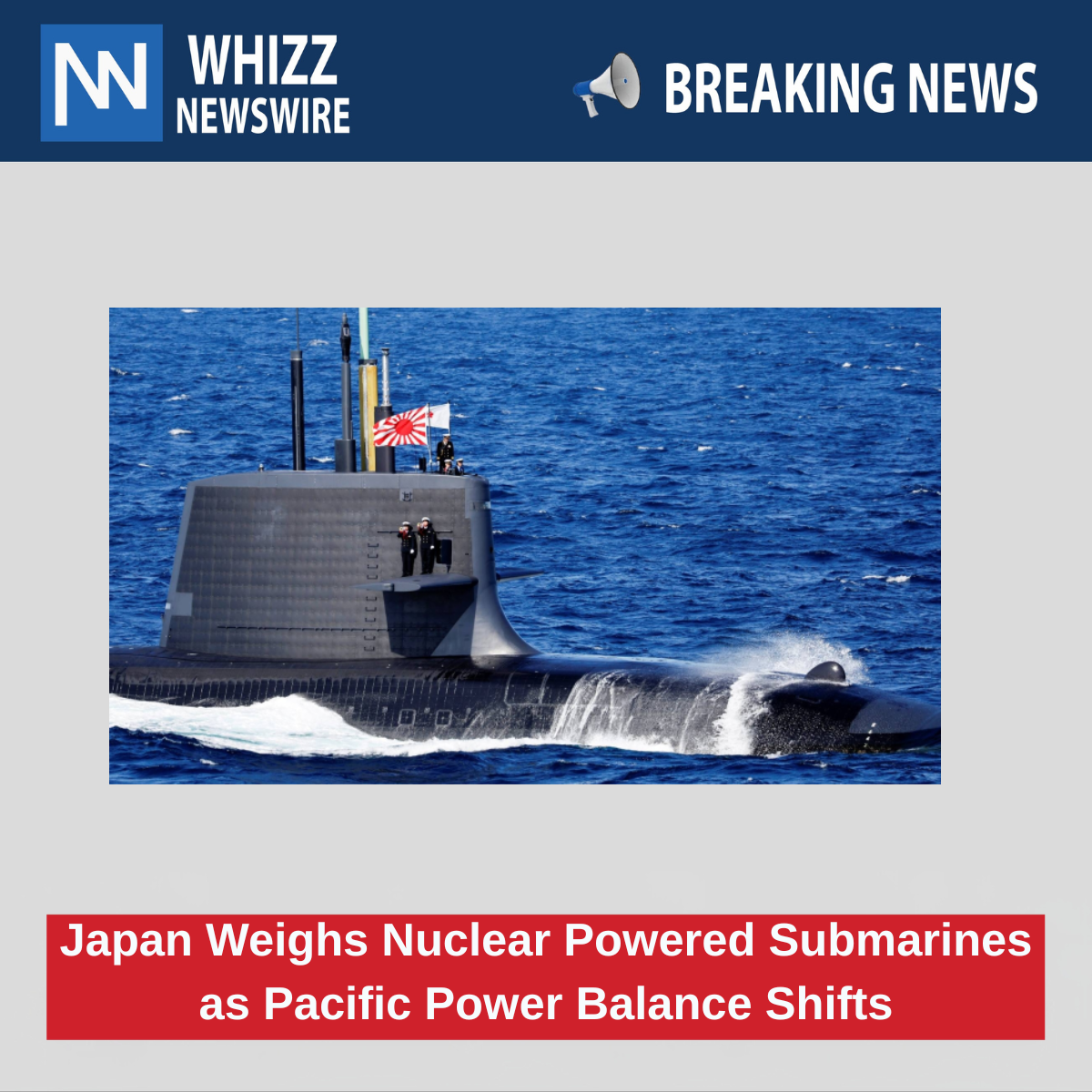
Japan is formally considering nuclear-powered attack submarines for the first time, breaking a decades-old policy taboo as it confronts China’s expanding navy, longer operating distances across the Western Pacific, and growing pressure to strengthen conventional deterrence beyond the First Island Chain. The move signals a potential turning point in Tokyo’s undersea strategy but it remains an assessment, not an approved acquisition.
What’s Being Reviewed and What Isn’t
Defence Minister Shinjiro Koizumi has said Japan will proceed while “not ruling them out as an option,” language that points to an authorised study rather than a green light for building or buying nuclear submarines. The review focuses on propulsion and force design, not nuclear weapons. Any future Japanese SSN would be conventionally armed, tasked with sea denial, anti-submarine warfare, intelligence gathering, carrier tracking and survivable counterstrike operations.
Tokyo is asking a hard question: can Japan’s world-class diesel-electric and lithium-ion battery submarines still meet the demands of a more dispersed battlespace? Officials cite nuclear propulsion’s operational advantages dramatically longer submerged endurance, higher sustained speeds and greater electrical power for sensors and weapons while acknowledging higher costs, larger hulls, specialised maintenance, demanding crew training and potentially weaker acoustic stealth compared with today’s quiet SSKs.
From Taboo to Policy Option: How the Debate Evolved
Nuclear propulsion was quietly examined during Japan’s 2004 defence guidelines but shelved due to legal constraints, cost, lack of naval-reactor expertise and domestic sensitivity around nuclear technology. For two decades it remained off the books, even as China’s navy grew and Japan modernised its conventional fleet with advanced batteries, sensors and acoustic treatments.
The barrier began to crack in 2024–2025. A Defence Ministry expert panel, set up to implement the 2022 security documents, recommended submarines equipped with vertical launch systems (VLS) for long-range missiles and the ability to stay submerged over extended distances. Its September 2025 report urged research into “next-generation propulsion systems without being bound by conventional precedents” a phrase broad enough to include naval reactors.
An October 2025 coalition agreement between the Liberal Democratic Party and Nippon Ishin no Kai turned that technical opening into policy, pledging next-generation-propulsion submarines capable of prolonged submerged movement while carrying long-range missiles in VLS cells. By June 2026, Nippon Ishin argued that only nuclear power could credibly reconcile heavy payloads, high-speed transits, long-distance patrols and sustained submerged operations, calling for immediate research investment and concrete deployment planning.
The Strategic Driver: China’s Reach and the Limits of Range
Japan currently operates roughly 22–23 attack submarines, centred on the Sōryū and lithium-ion-powered Taigei classes. These are exceptionally capable conventional boats, optimised for quiet operations near home waters. The issue isn’t obsolescence it’s geography and mission profile.
As Chinese naval activity extends farther into the Pacific, Tokyo is weighing whether conventional subs can rapidly cross oceanic distances, remain persistently submerged, power energy-hungry sensors and weapons, and exfiltrate predictably after launching future stand-off munitions. Former Defence Minister Gen Nakatani sharpened the argument in November 2025, stating Japan would “eventually need to use nuclear propulsion” because conventional fleets cannot match neighbouring nuclear submarines in underwater endurance or sustained transit speed.
Industrial Reality: A Long Road from Study to Steel
Even if nuclear propulsion wins policy approval, Japan faces a substantial implementation gap. There is no reactor design, nuclear-qualified shipyard, training pipeline, regulatory framework, construction funding or technology-transfer agreement in place today. That leaves a wide gulf between political permission to investigate SSNs and the industrial machinery required to deploy them.
The ongoing revision of Japan’s National Security Strategy, National Defense Strategy and Defense Buildup Program—expected by late 2026 will be a key indicator. If the documents use cautious verbs like “examine” or “study,” nuclear propulsion may remain exploratory. Stronger language such as “introduce” or “acquire” would signal bureaucratic commitment, funding priority and a future force-structure shift. Even with approval, the earliest operational Japanese SSN would likely sit well beyond the late 2020s, following years of concept work, legal arrangements, reactor research, workforce development and partner consultations.
Parallel Build-Up: VLS, Hypersonics and Counterstrike
While the nuclear question simmers, Tokyo is advancing undersea strike capabilities on conventional platforms. The Ministry of Defense has included plans in the FY2027 budget request to develop submarine-launched hypersonic missiles and to fund research into underwater VLS for larger long-range weapons. Existing Japanese submarines fire primarily through 533mm torpedo tubes; dedicated VLS would enable heavier payloads and more flexible loadouts for sea-denial and counterstrike missions.
These steps are designed to create a more survivable counterstrike posture one that can hold adversary bases and fleets at risk without relying solely on air-launched systems. They also send a clear signal to Beijing: Japan’s undersea force is evolving from a local area-denial asset into a longer-reach, higher-tempo component of Indo-Pacific deterrence.
What the Move Signals Regionally
By admitting nuclear propulsion into formal review, Tokyo is messaging multiple audiences China, Russia, North Korea, South Korea and the United States that its traditional model of quiet diesel-electric submarines concentrated near home waters is no longer strategically immutable. The debate itself is a deterrent signal, suggesting Japan is prepared to reconsider foundational constraints if the regional balance continues to shift.
For now, the policy door is open, but the path remains long and complex. The late-2026 strategy documents will reveal whether nuclear submarines stay a research topic or become an intended future capability and how quickly Japan is willing to walk that path.