
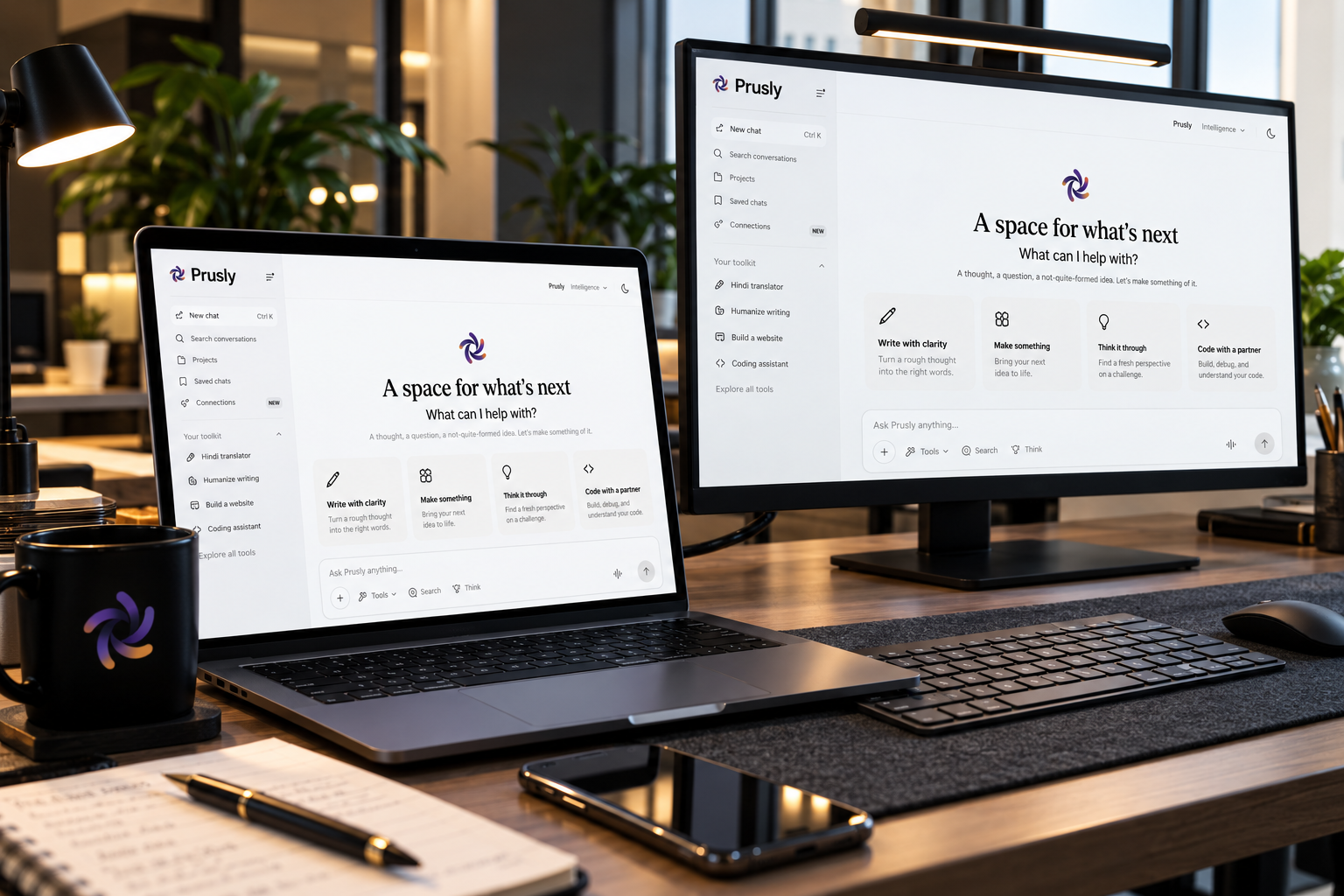
As artificial intelligence becomes part of everyday work, a new generation of AI platforms is emerging. Prusly is positioning itself as a space where people can write, solve problems, explore ideas, and turn everyday questions into meaningful work.
There was a time when using artificial intelligence felt like an experiment. People would open a chatbot, ask an unusual question, and marvel at how quickly a machine could respond.
That curiosity hasn’t disappeared, but expectations have changed.
Today, someone might use AI to prepare for a job interview in the morning, draft a business proposal in the afternoon, and troubleshoot a piece of code before dinner. A student might need help understanding a difficult concept, while a small business owner might be looking for a better way to communicate with customers.
In each situation, the underlying need is surprisingly similar: people want to spend less time figuring out where to begin and more time making progress.
That shift is creating opportunities for platforms such as Prusly, an AI chat workspace designed around writing, creativity, problem-solving, coding, and everyday productivity.
For people exploring a ChatGPT alternative, Prusly represents another option in an increasingly competitive market—one that emphasizes a straightforward place to work through ideas.
Why People Are Looking Beyond ChatGPT
ChatGPT helped introduce conversational artificial intelligence to a mainstream audience. It demonstrated that AI could do much more than answer factual questions. It could help write emails, explain complex topics, generate code, and provide a starting point for creative projects.
But as AI becomes more widely used, people are beginning to think differently about the tools they choose.
The question is no longer simply whether an AI chatbot can produce an answer.
It’s whether the experience fits the way someone actually works.
A marketing professional may want help refining a campaign without repeatedly explaining the same idea. An entrepreneur may need to move between business planning, writing, and technical questions. A developer might prefer an interface that makes it easy to explore code while keeping a conversation organized.
Others simply want a clean, approachable environment without unnecessary complexity.
These needs help explain why interest in AI chat alternatives continues to exist, even as established platforms expand their capabilities.
For emerging products, the opportunity isn’t necessarily to replace every feature offered by the largest AI companies. It’s to create an experience that people find genuinely useful.
What Is Prusly?
Prusly is an AI-powered conversational workspace accessible through Prusly.com.
Its brand message, “A space for what’s next,” reflects the idea that useful work often begins with an incomplete thought.
Visitors are greeted with a simple question:
“What can I help with?”
It’s a familiar invitation, but the surrounding experience is designed to encourage several kinds of work.
Users can begin with writing, creative exploration, problem-solving, or coding. Instead of requiring someone to arrive with a perfectly structured prompt, the interface invites them to start with what they already have.
That might be a sentence that needs improving, a question that needs explaining, or an idea that hasn’t yet taken shape.
The appeal of this approach is its simplicity. Many people don’t need a complicated AI workflow to get started. They need somewhere to ask a question, examine the response, and continue the conversation.
The Everyday Problems Prusly Aims to Solve
The most useful AI applications aren’t always the most dramatic ones.
Often, they address the small frustrations that consume time throughout the day.
1. Getting Past the Blank Page
Writing is one of the clearest examples.
Whether someone is preparing a professional email, a blog article, a social media caption, or a business introduction, the hardest part can be finding the first few words.
Prusly offers a conversational starting point.
A user can describe what they want to communicate, ask for a draft, and then refine the wording through follow-up questions.
Instead of treating the first response as the final product, they can use the conversation to improve clarity, tone, and structure.
For business owners and professionals who regularly need to communicate ideas, this kind of assistance can make the writing process feel less intimidating.
The value isn’t that AI eliminates the need for human judgment. It’s that it can help people move from an unfinished thought to something they can work with.
2. Making Difficult Information Easier to Understand
Information is widely available, but understanding it is another matter.
Technical terminology, unfamiliar business concepts, and complicated instructions can create unnecessary barriers.
An AI assistant can help explain information in simpler language, provide examples, or break a topic into manageable parts.
Consider someone trying to understand how a website works, why a marketing strategy isn’t performing, or what a particular programming concept means.
Rather than searching through multiple explanations and trying to connect them, the person can ask a direct question and continue asking until the subject becomes clearer.
Prusly’s conversational approach is intended to support that process.
As with any AI system, important factual claims still need verification, particularly in legal, financial, medical, or other high-stakes situations.
3. Helping People Think Through Decisions
Not every useful AI interaction begins with a request for content.
Sometimes, people simply need a way to organize their thinking.
A founder may be comparing two business ideas. A freelancer might be deciding how to structure a service package. A student could be weighing different approaches to a project.
In these situations, AI can help outline considerations, identify trade-offs, and suggest questions worth asking.
It shouldn’t make important personal or business decisions on someone’s behalf.
But it can serve as a useful sounding board, especially when someone needs to see a problem from more than one perspective.
Prusly includes this kind of exploration among its core use cases through its “Think it through” starting point.
4. Making Coding More Approachable
Software development can be challenging even for experienced programmers.
A small error can take considerable time to identify. Unfamiliar code can be difficult to interpret. And learning a new programming language often involves moving between documentation, examples, and experimentation.
Prusly presents coding assistance as another reason to start a conversation.
Users can ask for help understanding code, exploring possible solutions, or thinking through technical problems.
For beginners, that may mean explaining what a function does. For experienced developers, it might involve discussing alternative approaches or reviewing a logic problem.
AI-generated code still requires testing and security review. Nevertheless, conversational assistance can make technical exploration more accessible.
5. Turning Rough Ideas Into Something Useful
Creativity rarely follows a straight line.
Someone planning a new website might know the audience but not the structure. A content creator may have a topic but no compelling angle. An entrepreneur could have a business concept without knowing how to explain it.
Prusly’s “Make something” starting point speaks to this stage of the creative process.
Users can explore possibilities, request examples, and gradually shape an idea into a clearer direction.
AI doesn’t replace original thinking. Used well, it can provide the momentum that helps someone develop it.
Why the Experience Matters as Much as the Technology
AI companies frequently compete on technical benchmarks, model capabilities, and performance claims.
Those measurements matter. They help researchers and developers understand what systems can do.
But everyday users often judge software differently.
They notice whether the interface is confusing. Whether the next action is obvious. Whether they can find a previous conversation. Whether the product makes a simple task unnecessarily complicated.
Prusly takes a restrained visual approach, using a minimal interface, a conversation-focused workspace, and straightforward navigation.
Its design places the user’s question at the center of the experience rather than surrounding it with unnecessary distractions.
That may seem like a small detail, but usability becomes increasingly important when a tool is used repeatedly throughout the day.
The best interface is often the one people stop noticing because it lets them focus on the work itself.
Who Might Find Prusly Useful?
Prusly’s conversational approach makes it relevant to several kinds of users.
Writers and content creators can use it to explore topics, draft material, refine sentences, and develop creative directions.
Entrepreneurs and small business owners may find it useful for brainstorming, outlining plans, and preparing everyday communications.
Students and independent learners can ask for explanations, examples, and different ways of understanding unfamiliar subjects.
Developers and technically curious users can explore programming questions and work through coding challenges.
Everyday professionals can use conversational AI to organize ideas, improve drafts, and approach unfamiliar tasks with greater confidence.
These groups have different goals, but they share a common requirement: an accessible tool that helps them move forward.
Is Prusly Better Than ChatGPT?
That’s not a question that can be answered responsibly with a blanket claim.
ChatGPT is an established platform with a broad range of capabilities. Prusly is an emerging alternative with its own interface and product direction.
The right choice depends on what someone needs, which features are available, how reliably they work, and the overall experience.
A meaningful comparison would consider response quality, accuracy, supported tools, privacy practices, pricing, reliability, and ease of use.
Prusly doesn’t need to be described as universally better than ChatGPT to be worth exploring.
Its proposition is simpler: offer another environment where people can use conversational AI to work through questions and ideas.
For users who value a clean interface and an approachable starting point, that may be reason enough to try it.
The Bigger Opportunity for AI Chat Alternatives
The AI industry is still evolving, and user expectations are evolving with it.
As conversational AI becomes more common, people will increasingly expect these tools to fit naturally into their routines.
They will want to move between asking questions, working with information, creating content, and managing practical tasks without constantly switching environments.
For newer AI platforms, that creates both an opportunity and a challenge.
Adding more features is relatively easy to promise. Making those features reliable, intuitive, and genuinely helpful is much harder.
The companies that earn lasting trust will be those that deliver a consistent experience, communicate limitations clearly, and respect the importance of users’ work and information.
Prusly is entering this landscape with an emphasis on a simple AI workspace built around everyday needs.
Its long-term value will depend on how effectively the platform turns that vision into dependable functionality.
A Different Starting Point for Everyday AI
The most interesting thing about the next generation of AI tools may not be how much they can say.
It may be how effectively they help people do something useful.
An unfinished email becomes a clearer message. A confusing topic becomes easier to understand. A business idea gains structure. A coding problem becomes more manageable.
These are ordinary moments, but they are where technology can have a meaningful impact.
For anyone searching for a ChatGPT alternative, Prusly offers another place to begin that process.
And perhaps that’s the most relevant idea behind its tagline.
The future of AI isn’t only about having more powerful answers.
It’s also about giving people a better place to start.