
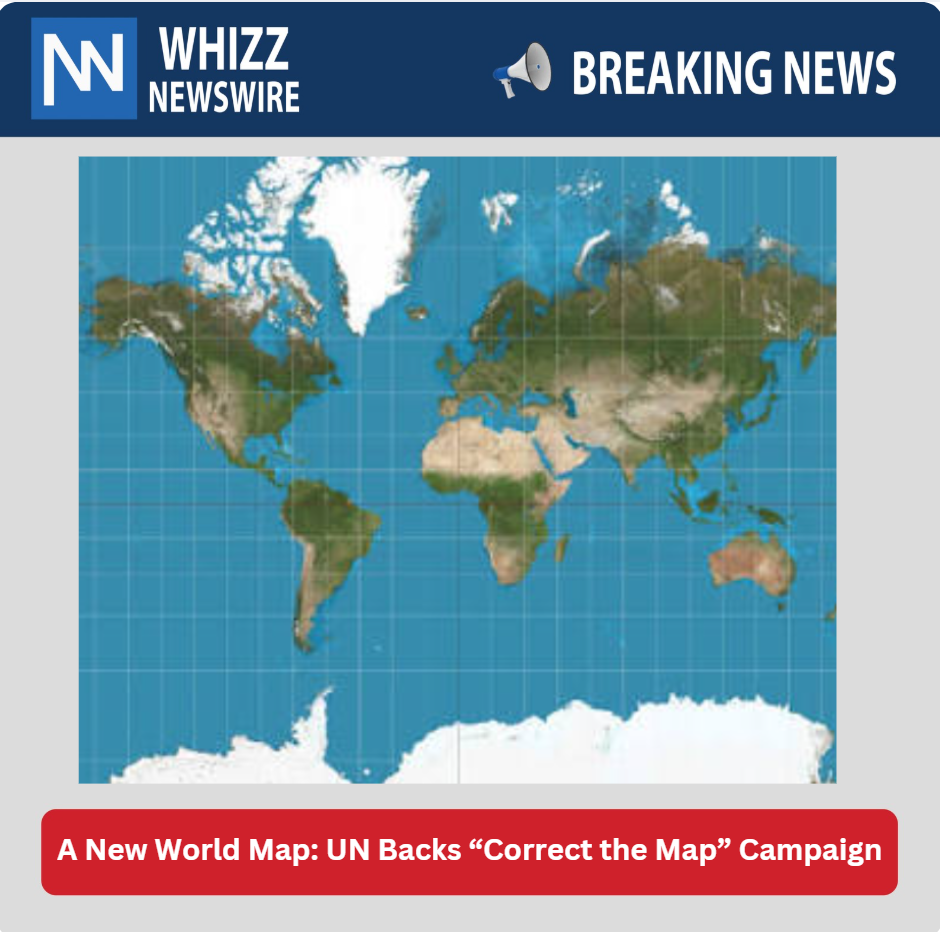
In a landmark vote, the United Nations General Assembly has endorsed a resolution encouraging governments, schools, and tech companies to move away from the centuries-old Mercator map in favor of more accurate, equal-area projections like Equal Earth. The measure passed with 164 votes in favor, one against (the United States), and six abstentions, marking a symbolic but powerful shift in how the world visualizes itself.
Why the Mercator Map Is Being Challenged
For more than 450 years, the Mercator projection created by Flemish cartographer Gerardus Mercator in 1569 has been the default for world maps. It was designed for maritime navigation, preserving straight-line angles so sailors could plot courses easily. But there’s a catch: it dramatically distorts the size of landmasses, especially those far from the equator.
The result? Greenland looks almost as big as Africa, when in reality Africa is about 14 times larger. Europe and North America appear outsized, while Africa, South America, and parts of Asia look smaller than they truly are. Critics say this distortion has shaped global perceptions for centuries, subtly reinforcing colonial-era biases about the importance and scale of different regions.
The “Correct the Map” Movement
The resolution, titled “Correct the Map: Rebalancing global cartographic representation and promoting equitable representation of the world’s regions, particularly Africa,” was introduced by Togo on behalf of the African Group at the UN and strongly backed by the African Union. It frames the shift as an act of “cognitive justice and memorial reparation,” aiming to correct a long-standing visual injustice.
The campaign promotes the Equal Earth projection, developed in 2018 by cartographers Tom Patterson, Bernhard Jenny, and Bojan Šavrič. Unlike Mercator, Equal Earth is an equal-area projection, meaning it preserves the relative sizes of continents much more accurately, even if shapes are slightly distorted.
Importantly, the resolution is not legally binding. It does not ban the Mercator projection or force anyone to adopt a new map. Instead, it encourages institutions to use equal-area projections when accurately representing land size matters—such as in education, public communication, and global reporting.
What This Means for Google Maps and Tech Platforms
The UN vote has reignited conversations about Google Maps, which has long relied on Mercator-based projections for its standard flat maps. Here’s what’s likely to happen:
- Navigation stays Mercator-friendly: For local, zoomed-in navigation, Google Maps and similar GPS platforms will likely continue using Mercator variants. That’s because the projection preserves angles and directions, which is essential for driving and walking directions.
- Global views are already evolving: When you zoom all the way out on Google Maps’ desktop web version, the interface switches to a 3D globe, which avoids the size distortions of flat maps. Activists and cartographers are now pushing tech giants to extend this accuracy to all standard flat-map views, especially for educational and informational contexts.
- Pressure is mounting: The resolution explicitly calls on technology companies to engage with UN member states and consider adopting more accurate projections. While no mandate exists, the political and public pressure could accelerate changes across digital platforms.
A Symbolic Victory with Real-World Impact
While the UN can’t force Google or national governments to redraw their maps, the resolution sends a clear message: the way we visualize the world matters. By promoting Equal Earth and other equal-area projections, the UN is encouraging a shift toward maps that reflect reality more faithfully—especially for regions historically minimized by the Mercator projection.
For educators, policymakers, and everyday map users, the takeaway is simple: no flat map is perfect, but some are more honest than others. The “Correct the Map” campaign isn’t about erasing Mercator—it’s about expanding our cartographic toolkit so that Africa, South America, and other equatorial regions finally appear in their true scale.