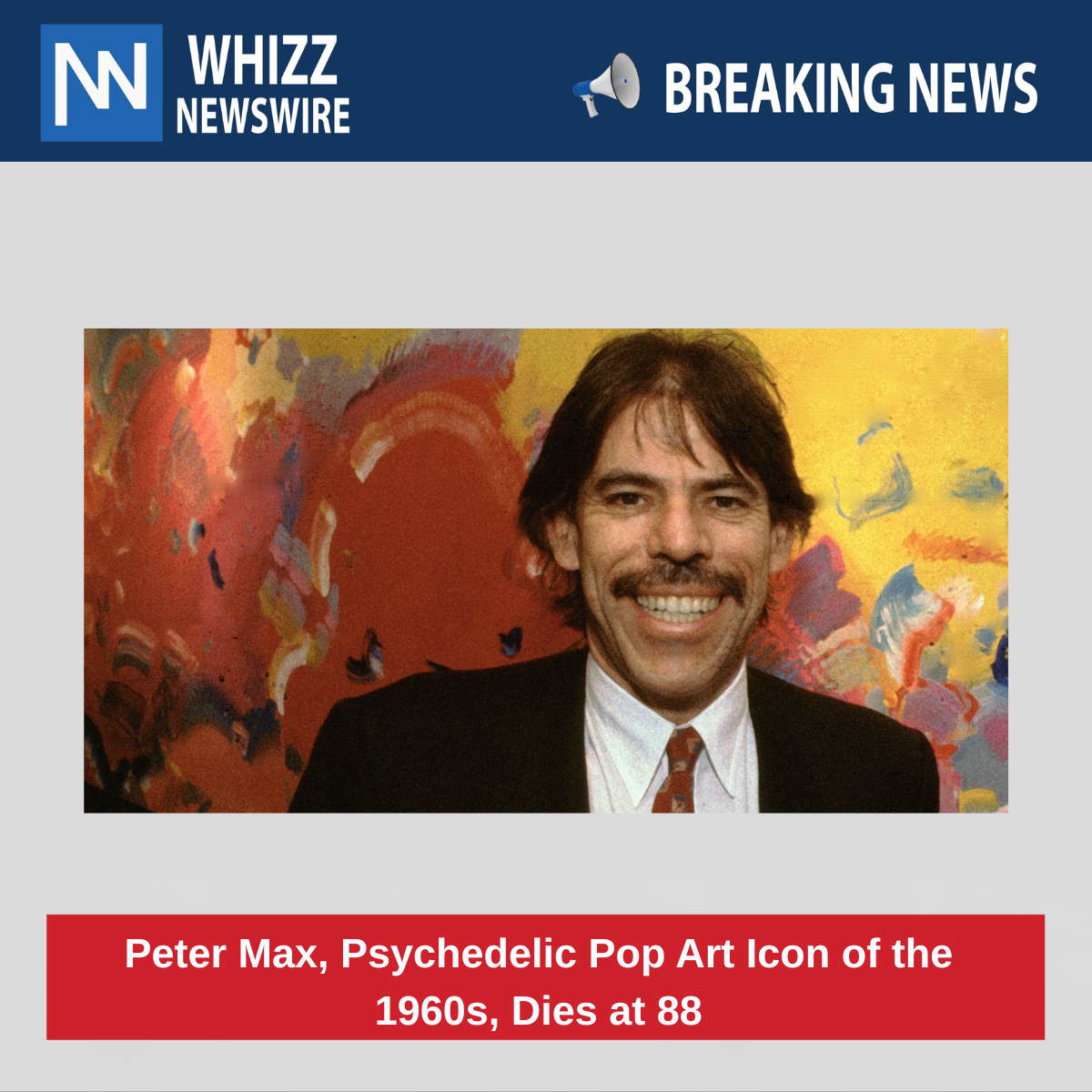
Peter Max, the American artist famous for his vibrant, rainbow-coloured pop art which came to symbolise the optimism of the 1960s “flower power” period, has died at the age of 88. According to a written statement from his son Adam Max, the artist died on Monday in New York having lived with severe dementia for several years. A specific cause of death was not provided.
From Refugee to Pop Art Superstar
Peter Max Finkelstein was born in Berlin in 1937 and, when he was still a baby, escaped Nazi Germany with his family; they first settled in Shanghai, then moved to Haifa, Israel, had a short stay in Paris and finally went to New York City in 1953 when he was sixteen. Later he stated that he had already been “a huge fan of American culture”, including comics, movies and jazz, and that the bright colours of the comic books and the Buddhist monasteries in Shanghai, together with his experiences in Israel, influenced his visual style.
Max attended the Art Students League, the School of Visual Arts and Pratt Institute in New York. In 1961 he founded a graphic design studio together with some friends. His bold, psychedelic style, characterised by cosmic landscapes, starbursts, doves, peace symbols, kaleidoscopic butterflies and puffy clouds in vivid turquoise, orange and neon green, was quickly adopted by advertising agencies, magazines and the corporate world.
“Flower Power” Everywhere: Posters, Products and Pop Culture
When Max was at the peak of his fame in the late 1960s and the early 1970s, his work was everywhere. His posters could be found on the walls of dorm rooms, and his designs appeared on a large number of products, including clocks, bedspreads, mugs, dresses, scarves and ties. He designed the covers for the Manhattan Yellow Pages and was on the cover of Life magazine in 1969, where his full mustache and broad smile became an integral part of his public image.
Max later became the official artist for a number of major events such as the Olympics, the Super Bowl, the Indianapolis 500, the World Cup, and the World Series. His paintings were created on a Boeing 777 and on a ship operated by Norwegian Cruise Line, and the people depicted in his portraits included U.S. presidents as well as Taylor Swift. Even though the art world at times has regarded his work as being too commercial, it has nevertheless been included in dozens of museum shows around the world, several of which are held at New York’s Museum of Modern Art.
A Return to Painting and High Profile Commissions
Even though he was a commercial success, Max stated that he felt ‘exploited’ and longed to paint again. In the early 1970s he closed down his studio in order to get back in touch with fine art. A significant phase in his return to the public eye was a series of portraits of the Statue of Liberty, which included some done at the White House at the request of First Lady Nancy Reagan in 1981 and a big mural in New York Harbor in the 1980s. He also kept close connections with Eastern spirituality, having helped bring Swami Satchidananda Saraswati to the United States and promoting yoga.
The artwork for the Beatles’ Yellow Submarine is frequently given incorrectly to him, but the official credit belongs to Heinz Edelmann. In a 2012 interview Max stated that he had carried out some early consulting on the design, and the galleries who represent his work refer to his role as advisory. He had remained close friends with the Beatles and a great many other celebrities throughout his life.
Controversies and Personal Struggles
Max’s career was not free from turbulence. In 1997 he admitted to tax fraud when the IRS claimed that he had hidden more than one million dollars of income from his art. Although he was originally sentenced to two months’ imprisonment, he eventually ended up serving a sentence in a work release programme, paid back the taxes and a fine of $30,000,