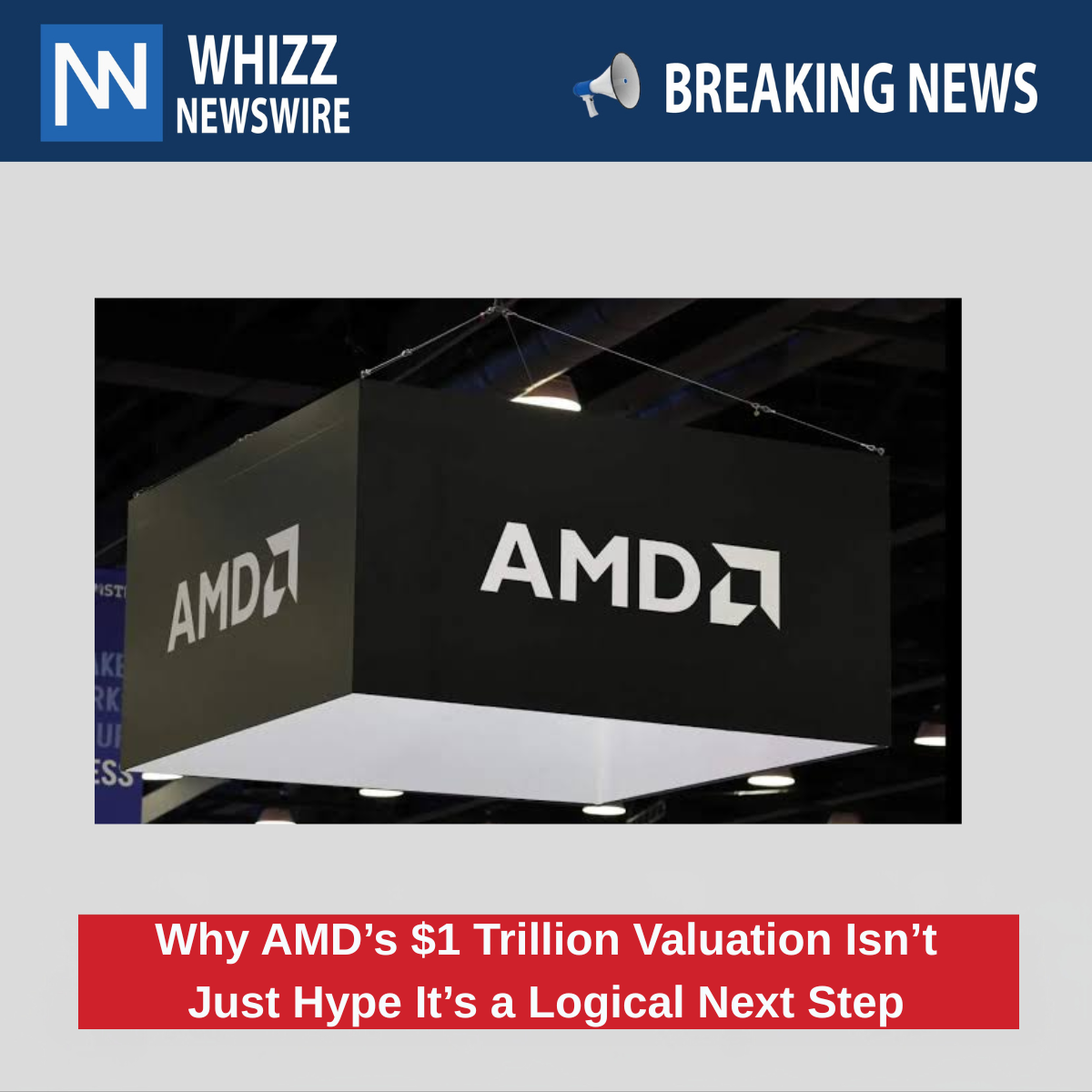
Advanced Micro Devices has now officially joined the most exclusive group in the technology industry: the segment comprising companies with a market capitalisation of $1 trillion. On Monday, the value of AMD’s shares rose by almost 10%, enabling the chip company to pass the mark for the first time and completing a year-to-date increase of 185%. This development wasn’t by chance. It reflects the market at last incorporating the transformation that CEO Lisa Su has been carrying out for over ten years, as well as a series of successes in the field of artificial intelligence that have established AMD as Nvidia’s most credible competitor.
From Near-Bankruptcy to AI Powerhouse
When Lisa Su joined AMD in 2012 and became CEO in 2014, the company was having difficulty in competing with Intel in the area of CPUs and did not have any significant presence in accelerators. She revised the company’s roadmap, introduced the Ryzen and EPYC architectures, and regained AMD’s engineering credibility. The acquisition of Xilinx brought in leading adaptive computing and FPGA technology, completing a product range that could deal with everything from personal computers to data centres.
AMD is not only being rewarded for its previous performance but also because it has a clear route to continued growth in the field of AI infrastructure; investors view it as a company that has progressed from being a minor player to one that is now a strategic supplier to the world’s largest cloud and AI companies.
The Numbers Behind the Rally
The hard data from AMD’s most recent quarterly results showed the point clearly. Revenue in the second quarter rose by 50% on a year-on-year basis to reach a record $11.54 billion, and non-GAAP earnings per share of $1.66 exceeded expectations. The Data Center segment was the main driver of this growth, its revenue more than doubling to $6.7 billion as a result of increased demand for EPYC server CPUs and Instinct AI accelerators.
The forward guidance issued by management has strengthened this trend. AMD anticipates that its server CPU revenue will increase by around 80% in the second half of 2026 and by 70% in 2027, while data centre revenue is expected to more than double in 2027 as a result of the accelerated shipment of AI GPUs. Such clarity is uncommon in the semiconductor industry and is precisely what growth investors are looking for.
Helios, MI450 and the Push Into Rack-Scale AI
AMD is changing its product strategy so that it moves from selling individual chips to offering integrated AI systems. The company has recently launched the Instinct MI450 Series GPUs and 6th-Gen EPYC “Venice” CPUs, both of which are intended to support its new Helios rack-scale AI platform. Helios combines the GPUs, the CPUs, high-speed networking and the system software into one optimized stack for large-scale training and inference.
The reason this systems-level approach is important is that it enables AMD to bid for whole AI deployments, not just individual accelerators; it also corresponds to the way hyperscalers and large AI laboratories are purchasing, namely by the rack, by the cluster, and by the gigawatt.
Mega-Deals That Anchor the $1 Trillion Story
The valuation leap is underpinned by a wave of multi-year commitments that read like a who’s-who of AI:
Microsoft
AMD has confirmed that Microsoft will begin deploying Helios systems on its Azure AI services from the second half of 2026, thus giving AMD a significant presence in one of the largest cloud platforms in the world.
Anthropic
As part of one of the most important infrastructure transactions of the year, the company intends to install up to 2 gigawatts of Instinct MI450 GPUs in Helios racks starting in the first half of 2027. AMD has also pledged an investment of up to $5 billion in Anthropic, linking its future closely to one of the leading frontier-model research labs.
OpenAI and Meta
There are reports stating that OpenAI and Meta have committed to purchasing multi-gigawatt GPUs, with OpenAI agreeing to buy up to 6 GW and Meta agreeing to buy up to 6 GW worth of custom MI450 systems, and the first deliveries are expected during the second half of 2026. Even if these commitments are scaled up over time, they still represent potential revenues in the tens of billions.
Put together, these agreements turn AMD from a provider of components into a strategic infrastructure partner for the companies that are defining the AI era.
Why the Market Is Re-Rating AMD Now
For many years AMD was priced at a discount to Nvidia even though it had strong execution; this year, however, the gap is decreasing since the AI story has changed from ‘Nvidia or nothing’ to ‘diversify supply chains and pricing’. The hyperscalers are seeking leverage, and AMD’s Helios plus MI450 stack provides a reasonable alternative on a large scale.
The 185 per cent increase in the stock price to date is a result of the re-rating. Rather than being merely optimistic about the eventual recovery of cyclically affected personal computers and servers, investors are now supporting a multi-year build-up of AI infrastructure in which AMD is one of the main beneficiaries.
Risks to Watch
The fact that the company is valued at $1 trillion also sets a higher standard. There is a real execution risk since AMD has to increase production of the MI450, deliver Helios on time and ensure its software remains competitive with Nvidia’s ecosystem. Competition is becoming more intense as Nvidia is still carrying out innovation and custom silicon projects are increasing within the major cloud providers. Moreover, given that the share price is more than 100 times earnings, there is little room for error.
Yet the direction in which it is heading is obvious. Because of its differentiated product roadmap, its systems-level strategy, and its backlog of major AI commitments, AMD’s route to and beyond $1 trillion seems less like a bubble and more like the natural result of a decade-long turnaround finally coming to an end.